


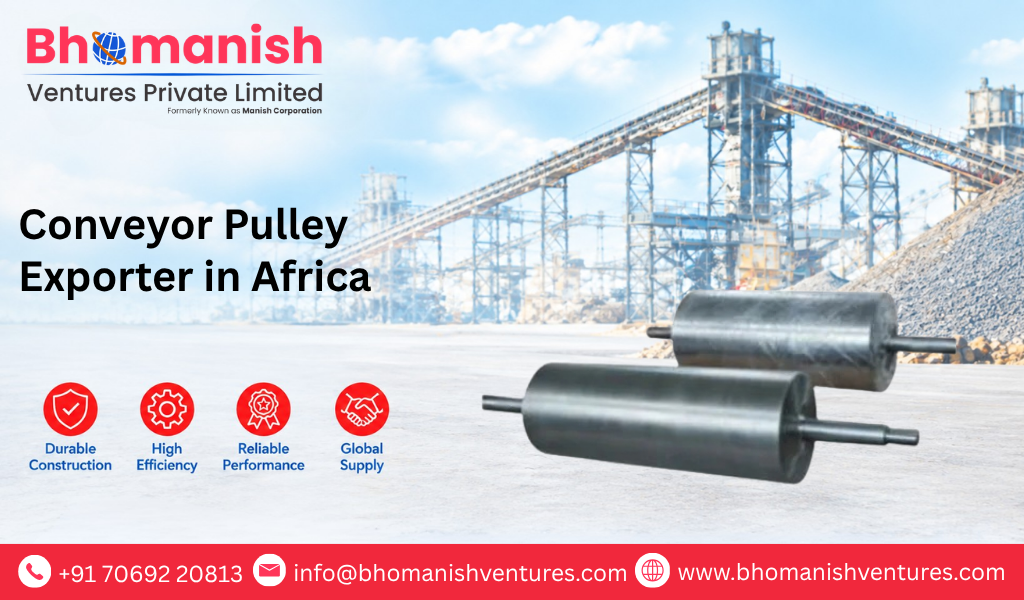
Conveyor Pulley Exporter in Africa
Selecting the right conveyor pulley is important for maintaining stable belt movement, controlled material handling, and dependable conveyor performance. Buyers in mining, cement, aggregates, steel, ports, power generation, and bulk-material industries often require pulleys that match their conveyor configuration, operating conditions, belt dimensions, and loading requirements. Conveyor Pulley Exporter in Africa solutions therefore need to be selected according to the actual application rather than only by size or price. Bhomanish Ventures Private Limited supports industrial buyers with application-focused sourcing and supply of conveyor pulley solutions for different material-handling requirements.
What Is a Conveyor Pulley and How Does It Work?
A conveyor pulley is a rotating cylindrical component positioned within a belt conveyor system. It supports belt movement and helps transmit or control belt tension depending on its location and function. Drive pulleys transfer rotational force to the conveyor belt, while other pulley arrangements can assist with belt direction, tension management, or belt tracking.
The appropriate Conveyor Pulley Exporter should understand the relationship between pulley construction, belt width, conveyor arrangement, loading conditions, and operating environment. Instead of treating every pulley as a standard component, buyers should identify the pulley position and its intended duty before confirming an order.
Material and Technical Considerations
Pulley selection involves more than choosing a diameter. The shell, shaft, hub arrangement, bearing interface, and surface configuration should be considered according to the conveyor's operating conditions. Material selection also depends on expected loads, environmental exposure, corrosion concerns, and operating temperature.
A suitable Conveyor Pulley Manufacturer evaluates factors such as belt tension, rotational speed, material characteristics, conveyor geometry, and installation conditions. Depending on the application, surface treatment or lagging may also be considered where additional traction or belt protection is required.
Buyers should provide accurate conveyor information before requesting a Conveyor Pulley Price in Africa. Useful information can include belt width, pulley position, shaft arrangement, approximate operating conditions, required quantity, and available drawings or existing pulley dimensions. This reduces the possibility of receiving a component that does not match the existing conveyor assembly.
Key Features and Performance Benefits
A properly selected pulley can contribute to smoother belt operation and more consistent power transmission. Its performance depends on correct engineering, manufacturing accuracy, suitable materials, and compatibility with the complete conveyor system.
When evaluating a Top Conveyor Pulley Exporter in Africa, buyers should consider:
- Application-specific pulley configuration
- Suitable shaft and hub arrangement
- Appropriate shell construction
- Compatibility with the conveyor belt
- Correct bearing and mounting interface
- Surface finish or lagging requirements where applicable
- Dimensional consistency for installation
- Documentation and technical communication
The objective should not simply be to Buy Conveyor Pulley in Africa at the lowest initial price. A pulley that is correctly matched to the conveyor can help avoid premature replacement, installation difficulties, and unnecessary operational interruptions.
Industry Applications Across Africa
Conveyor pulleys are used in a wide range of bulk-material and industrial conveying systems. Mining operations may use conveyor systems for transporting extracted minerals, ores, and overburden. Cement and aggregate plants rely on conveyors for moving raw materials and processed products. Ports and terminals may use belt conveyors for bulk cargo handling, while steel and power facilities can require conveying systems for raw materials and process materials.
For these applications, a Conveyor Pulley Supplier in Africa needs to understand that operating conditions can vary significantly from one facility to another. Dust, abrasive materials, moisture, continuous operation, heavy loading, and demanding conveyor layouts can all affect component selection.
In a replacement situation, matching the existing pulley dimensions and interface can be just as important as selecting the material. Buyers looking for Conveyor Pulley in Africa should therefore share available drawings, photographs, component markings, or dimensional details wherever possible.
Common Buyer Requirements and Selection Guide
One common purchasing problem is ordering a pulley using only a general description such as “standard conveyor pulley.” Conveyor systems can differ considerably, so the pulley should be specified according to its actual position and duty.
Before placing an order or requesting a quotation, buyers should check:
- Pulley function: Identify whether it is a drive, tail, bend, take-up, snub, or another conveyor pulley application.
- Dimensions: Confirm shell diameter, face width, shaft dimensions, and mounting details.
- Belt information: Provide belt width and relevant conveyor specifications.
- Operating environment: Mention abrasive, dusty, wet, corrosive, or other conditions.
- Load and operating duty: Explain whether the conveyor operates continuously or intermittently and identify demanding loading conditions.
- Replacement requirements: Where replacing an existing pulley, provide drawings or measured dimensions.
- Quantity and delivery: Confirm the required quantity and destination for accurate commercial planning.
If a buyer searches for Conveyor Pulley Exporter Near me, geographical proximity should not be the only consideration. Technical communication, manufacturing capability, dimensional accuracy, documentation, and suitability for the intended application are also important purchasing factors.
Supply, Maintenance and Buyer FAQs
For international industrial procurement, buyers should confirm the product configuration, packing requirements, shipping destination, documentation, and commercial terms before finalizing an order. Bhomanish Ventures Private Limited can work with buyers to understand their application and determine the information required for an appropriate conveyor pulley quotation. Availability, delivery schedules, and Conveyor Pulley Price in Africa should be confirmed according to the specific requirement rather than assumed from a generic market price.
Routine inspection should include checking pulley surfaces, bearings, shaft interfaces, mounting arrangements, and signs of abnormal wear or misalignment. Any unusual vibration, belt tracking issue, noise, or visible damage should be investigated before continued operation creates additional problems.
Frequently Asked Questions
1. What information is needed to select a conveyor pulley?
Important information includes pulley function, belt width, pulley dimensions, shaft details, mounting arrangement, operating conditions, and available drawings or existing component measurements.
2. How is Conveyor Pulley Price in Africa determined?
Pricing depends on the pulley configuration, dimensions, materials, quantity, manufacturing requirements, packing, and delivery destination. A project-specific quotation is more reliable than a generic price.
3. Can I Buy Conveyor Pulley for Sale in Africa for an existing conveyor?
Yes, replacement requirements can be evaluated using existing pulley dimensions, drawings, photographs, shaft details, and conveyor information.
4. What is the difference between a pulley supplier and manufacturer?
A supplier handles sourcing and supply, while a manufacturer produces the component. Depending on the project, buyers may work with a company offering manufacturing, sourcing, or both capabilities.
5. Why is pulley compatibility important?
A pulley must properly interface with the conveyor belt, shaft, bearings, mounting structure, and surrounding components. Incorrect dimensions can create installation or operational problems.
6. How should conveyor pulleys be maintained?
Inspection should focus on bearings, shaft connections, pulley surfaces, mounting points, belt alignment, and visible wear. Maintenance intervals should follow the conveyor manufacturer's recommendations and actual operating conditions.
7. Can Bhomanish Ventures Private Limited supply conveyor pulleys for African projects?
Supply requirements should be evaluated according to the required configuration, quantity, destination, and documentation. Buyers can provide their technical requirements for application-specific quotation and supply discussion.
Tags : Conveyor Pulley Exporter in Africa, Top Conveyor Pulley Exporter in Africa, Best Conveyor Pulley Exporter in Africa, Conveyor Pulley Exporter, Conveyor Pulley Manufacturer, Conveyor Pulley Exporter Near me, Conveyor Pulley in Africa, Conveyor Pulley Supplier in Africa, Conveyor Pulley Price in Africa, Buy Conveyor Pulley in Africa, Buy Conveyor Pulley for Sale in Africa, Conveyor Pulley Exporter in Johannesburg, Conveyor Pulley Exporter in Durban, Conveyor Pulley Exporter in Lagos, Conveyor Pulley Exporter in Cairo, Conveyor Pulley Exporter in Alexandria, Conveyor Pulley Exporter in Accra, Conveyor Pulley Exporter in Nairobi, Conveyor Pulley Exporter in Tunis.